Open source ERP solutions overview
The solutions below cover very different product philosophies: turnkey ERP suites, lightweight business tools, application frameworks and operations-focused platforms.
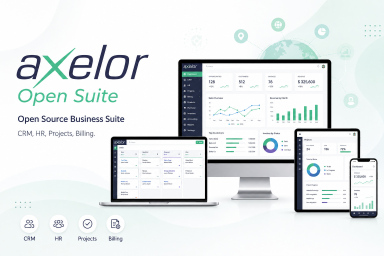
Axelor Open Suite
A modern ERP platform combining packaged applications with Studio, BPM and low-code customization.
Interesting for process-heavy organizations needing graphical adaptation.
View analysis →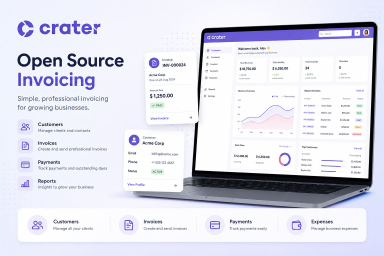
Crater
A lightweight self-hosted invoicing application covering customers, estimates, invoices, recurring billing, payments and expenses.
Focused on invoicing rather than full ERP depth; upstream maintenance is currently uncertain.
View analysis →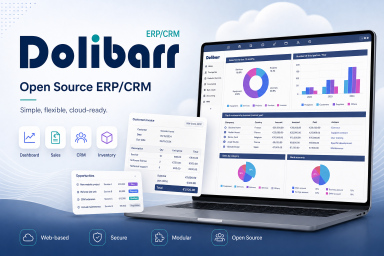
Dolibarr
A pragmatic management suite aimed at small organizations, associations and straightforward business workflows.
Low adoption barrier and conventional web stack.
View analysis →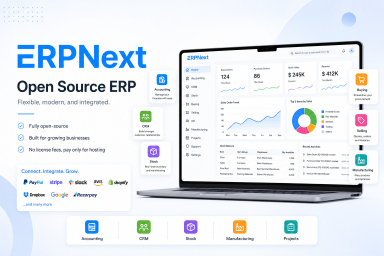
ERPNext
A coherent ERP built on the metadata-driven Frappe framework, with strong transactional integration.
Well suited to structured processes and integrated operations.
View analysis →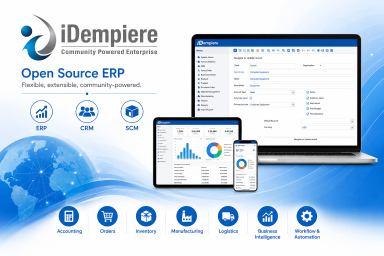
iDempiere
A mature community-driven ERP/CRM/SCM platform combining traditional enterprise depth with a modern OSGi-based extension architecture.
Actively maintained successor to ADempiere with regular releases and a modular plugin model.
View analysis →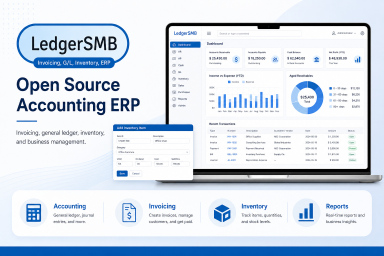
LedgerSMB
A mature web-based accounting and ERP system combining double-entry bookkeeping with sales, purchasing, projects and inventory workflows.
Strong accounting focus with PostgreSQL at the centre of the architecture.
View analysis →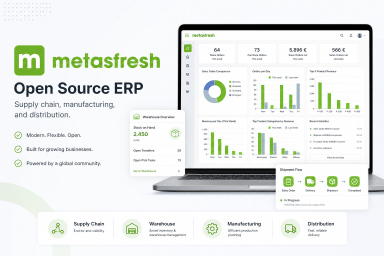
metasfresh
An open source ERP focused on supply chain, trade, inventory and logistics-heavy workflows.
Strong orientation toward inventory-driven operations.
View analysis →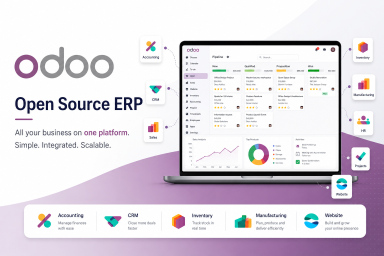
Odoo
A broad ERP ecosystem combining standard business applications with a mature extension framework.
Strong fit when standard ERP processes cover most requirements.
View analysis →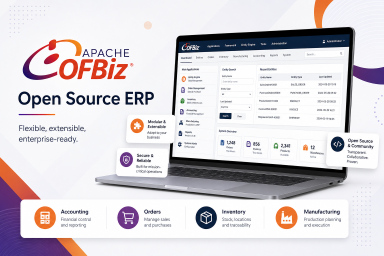
Apache OFBiz
An enterprise application framework and ERP suite designed for substantial custom business systems.
Powerful, but development resources are part of the model.
View analysis →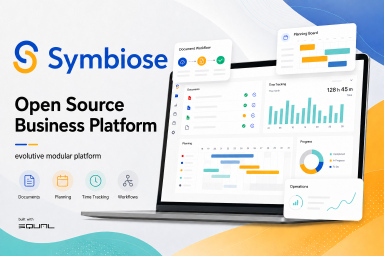
Symbiose ERP
A modular ERP foundation combining reusable business functionality with fine-grained adaptation to domain-specific workflows.
Built on eQual for adaptability, integration and long-term maintainability.
View analysis →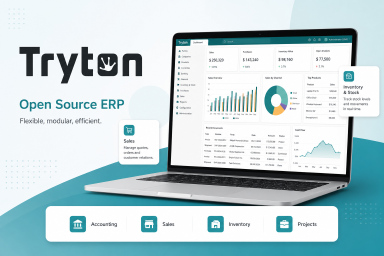
Tryton
A modular ERP foundation with strong architectural discipline and a long-term maintainability focus.
Best when tailored business software is part of the plan.
View analysis →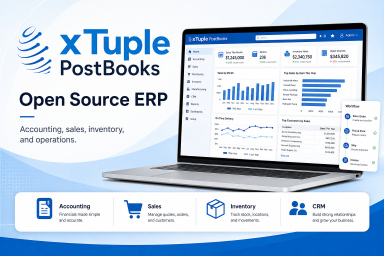
xTuple PostBooks
A historically important manufacturing and distribution ERP whose public open source ecosystem is now largely legacy.
Relevant mainly for existing installations or historical comparison.
View analysis →Different products, different philosophies
Open source ERP is not a single product category. Odoo, ERPNext and Axelor start from broad packaged functionality. Dolibarr emphasizes simplicity, while Crater focuses even more narrowly on invoicing and lightweight business management. LedgerSMB takes an accounting-centric approach. Tryton, OFBiz and Symbiose behave more like ERP foundations. metasfresh concentrates on operational execution, while iDempiere combines traditional enterprise ERP depth with a more actively maintained modular architecture.
What matters long term
The quality of an ERP decision is usually determined less by the first demo than by upgrade strategy, ownership of custom code, availability of expertise, project activity, database and API architecture, and how much the software must bend to match the real organization.
iDempiere
Community-driven ERP/CRM/SCM platform evolved from ADempiere, with a modular OSGi architecture and active release cycle.
Overview
iDempiere is an open source ERP, CRM and supply-chain platform that forked ADempiere in 2011 and has evolved independently since then. It retains the mature business concepts inherited from the Compiere and ADempiere lineage while continuing to receive regular functional, architectural and security improvements.
Functional scope
The platform covers core enterprise areas including accounting, sales, purchasing, inventory, supply chain, manufacturing, CRM and point-of-sale concepts. It also supports multi-organization, multi-company, multi-language, multi-currency and multiple accounting-schema scenarios.
Architecture and extensibility
iDempiere is Java-based and uses the Equinox implementation of OSGi as its modular foundation. Extensions are packaged as OSGi plug-ins, allowing additional functionality to be introduced without modifying the core. Current system requirements specify OpenJDK 17 or later and PostgreSQL 14 or later, with Oracle also supported.
Project maturity
The project has a long release history and remains actively maintained. iDempiere 13 “Orion” was released in March 2026 as the recommended maintained release, while the public repository and pull-request activity continued through July 2026.
Assessment
iDempiere is a stronger contemporary choice than ADempiere for organizations attracted to the traditional Compiere-derived ERP model. It combines substantial accumulated ERP functionality with an actively maintained community project and a cleaner plugin-oriented architecture. The trade-off remains implementation complexity: it is a substantial enterprise platform and generally benefits from experienced integrators or developers.
Axelor Open Suite
Integrated ERP combining conventional business applications with low-code customization and BPM.
Overview
Axelor combines an ERP suite with an application development platform. Its business modules cover CRM, sales, accounting, purchasing, inventory, manufacturing, projects and related domains, while Studio and BPM components support graphical customization and process automation.
Architecture
Axelor Open Platform is Java-based and uses PostgreSQL for current production deployments. Its modern web frontend is React-based, and REST integration is part of the platform strategy.
Low-code and BPM
Axelor Studio can modify screens and data fields through graphical tooling, while BPM capabilities allow processes to be modeled and executed over ERP data. This can reduce the amount of conventional custom development for workflow-heavy requirements.
Assessment
Axelor occupies an interesting position between traditional ERP products and low-code platforms. It is particularly relevant where substantial workflow adaptation is expected, but edition boundaries and commercial features should be evaluated carefully.
Crater
Self-hosted open source invoicing application for individuals and small businesses.
Overview
Crater is an open source web and mobile invoicing application designed for individuals and small businesses. Its functionality includes customers, items, estimates, invoices, recurring invoices, payments, expenses, taxes, reports and general business settings.
Its scope is narrower than a conventional ERP: Crater is best understood as a focused invoicing and lightweight financial-management application rather than a system covering purchasing, manufacturing, supply chain or full accounting depth.
Architecture and extensibility
The web application is built with Laravel and Vue.js, while the historical mobile applications use React Native. This gives Crater a familiar modern web stack for organizations already comfortable with PHP and JavaScript technologies.
Current status
The original crater-invoice-inc/crater repository remains publicly accessible under the AGPL, but its last recorded push was in August 2024. Public issues and pull requests continued afterwards, including discussion around archiving the original project and moving toward maintained forks. New deployments should therefore evaluate maintenance and security strategy carefully rather than assuming an actively maintained upstream.
Assessment
Crater remains an interesting example of a self-hosted open source invoicing product with a clean, focused feature set. It can still be relevant for existing installations or organizations prepared to maintain the code themselves, but a greenfield project should compare it with actively maintained successors or alternatives before adoption.
Dolibarr
Pragmatic business management software with a relatively low adoption barrier.
Overview
Dolibarr is an open source ERP and CRM built around a straightforward principle: enable the business functions that are needed and leave the others disabled. It targets freelancers, associations and organizations looking for practical management software without the weight of a large ERP program.
Functional scope
Its modules cover customers, suppliers, CRM, quotations, sales and purchase orders, invoicing, payments, products and services, inventory, projects, accounting-related functions, HR and agenda management.
Architecture and extensibility
Dolibarr is a conventional web application primarily written in PHP. External modules can add business classes, pages, JavaScript, CSS, SQL tables, triggers and administration settings without modifying the application core.
Assessment
Dolibarr occupies an effective middle ground between simple invoicing software and a full ERP. Its strongest argument is proportionality: for organizations whose processes remain straightforward, it can deliver enough functionality without introducing disproportionate technical and organizational complexity.
ERPNext
Coherent, structured ERP built on the metadata-driven Frappe application framework.
Overview
ERPNext combines accounting, sales, purchasing, inventory, manufacturing, projects and other business domains within a consistent application and data model. It is particularly attractive to organizations that want one integrated system and are prepared to structure operations around clearly defined documents and workflows.
Architecture and extensibility
ERPNext runs on Frappe, a full-stack framework primarily written in Python and JavaScript. Business entities are represented as DocTypes, from which database structures, forms and permissions can be generated or configured. The framework also provides background jobs, caching, authentication, realtime functions and REST APIs.
Operational depth
ERPNext integrates operational transactions closely with accounting and includes significant capabilities around inventory and manufacturing, including bills of materials, work orders, workstations, planning and quality-related processes.
Assessment
ERPNext successfully combines a conventional ERP product with a capable application framework. Its model-driven approach makes it attractive where controlled customization is required without abandoning an integrated ERP base.
LedgerSMB
Accounting-led open source ERP combining double-entry bookkeeping with operational business workflows.
Overview
LedgerSMB is a web-based open source accounting and ERP system for small and medium-sized businesses. Its functional scope includes double-entry accounting together with quotations, ordering, invoicing, projects, timecards, inventory management, shipping and related business workflows.
Architecture and extensibility
LedgerSMB is primarily developed in Perl and stores its business data in PostgreSQL. It is deployed as a browser-based application behind a web server, and its document and output system supports customizable templates and formats including PDF, CSV, HTML and ODF.
Accounting orientation
Accounting is the centre of gravity of LedgerSMB rather than one module among many. This makes it particularly relevant for organizations that want operational workflows to remain closely connected to a mature double-entry accounting foundation instead of adopting a very broad application catalogue.
Assessment
LedgerSMB occupies a distinctive position among open source ERP projects: it is narrower than large all-in-one suites but substantially deeper than simple invoicing tools. Its PostgreSQL-based architecture, long project history and active release policy make it a credible option where financial control and accounting-led processes are the primary requirements.
metasfresh
Operations-oriented ERP with strong emphasis on trade, inventory and supply-chain execution.
Overview
metasfresh is primarily aimed at companies operating in trade, distribution and industry. Purchasing, order processing, inventory and logistics are central parts of the product, making it more operations-centric than lightweight administrative ERP systems.
Architecture and extensibility
The platform uses a three-tier architecture with a predominantly Java backend, PostgreSQL and a modern web frontend. REST-based interfaces and Docker deployment resources are part of the ecosystem.
Functional orientation
Its strengths lie in purchasing, sales order handling, stock, logistics and operational flows where physical goods, traceability and execution matter more than generic office administration.
Assessment
metasfresh is a more specialized choice than Odoo or ERPNext. For organizations where inventory, purchasing and logistics represent the core of daily operations, that specialization can be a significant advantage.
Odoo
Broad functional coverage backed by a very large application, partner and integration ecosystem.
Overview
Odoo is one of the most visible open source ERP platforms. Its architecture is based on a relatively small core extended through applications covering CRM, sales, purchasing, inventory, accounting, manufacturing, project management, e-commerce, websites and many other business functions.
The usual implementation model is progressive: organizations activate the applications they need and extend their installation as requirements grow.
Functional scope
Odoo offers unusually broad functional coverage for an ERP platform. This makes it possible to consolidate many previously separate business applications into a single environment, but it also means that an installation can evolve into a sizeable information system over time.
Architecture and extensibility
Odoo is primarily developed in Python and uses PostgreSQL. Functionality is packaged into modules, including custom modules that can be loaded alongside the standard applications. New business objects, views, workflows and integrations can therefore be implemented without rewriting the platform.
Assessment
Odoo's main strength is the combination of a broad application catalogue and a capable extension framework. For organizations whose processes largely correspond to conventional ERP workflows, it can provide an unusually complete environment. The principal architectural risk is uncontrolled accumulation of custom modules, marketplace dependencies and upgrade constraints.
Apache OFBiz
Highly extensible enterprise application framework and ERP suite governed by the Apache Software Foundation.
Overview
Apache OFBiz is simultaneously an ERP suite and a development framework. It provides reusable business applications, a common enterprise data model and infrastructure for developers building tailored systems.
Architecture and extensibility
OFBiz is predominantly Java-based. Its architecture includes a web layer, MVC framework, Entity Engine for persistence and modelling, Service Engine for business logic and a widget system for user interfaces. Applications and plugins are built on top of these foundations.
Functional scope
The project contains reusable concepts and functionality for accounting, orders, inventory, manufacturing, CRM, HR, e-commerce, warehouse management and point of sale.
Assessment
OFBiz should be compared more directly with ERP frameworks than with lightweight products. Its value lies in reusable enterprise architecture and data models, but this flexibility transfers more responsibility for the final application to the implementation team.
Symbiose ERP
Adaptable business application foundation combining a ready-to-use ERP baseline with fine-grained domain-specific customization.
Overview
Symbiose is developed by YesBabylon and provides a reusable ERP and business application foundation rather than an exhaustive catalogue of fixed applications. A functional baseline is available for common business requirements, while the platform is specifically designed to let entities, screens, workflows and business rules be adapted closely to the actual operating model of an organization.
This makes it possible to start from existing business foundations rather than from a blank application, while retaining the ability to implement highly specific domain logic when standard ERP workflows are not sufficient.
Architectural approach
Symbiose is built on the eQual framework, a modular business-oriented application framework designed to separate domain models, business operations, presentation and persistence concerns. Applications are organized into packages defining object classes, business operations, views, translations and other reusable components.
Business controllers can be invoked through HTTP, the command line or internal PHP calls, allowing the same application logic to be reused across user interfaces, external integrations, scheduled tasks and automated processes.
Technical foundation
The platform is based on PHP and can be deployed behind Apache or Nginx, with Docker-compatible deployment approaches. eQual provides its own ORM and data abstraction mechanisms, reducing the coupling between business models and a specific database implementation.
This architecture allows the persistence layer to be adapted to different relational database management systems, including MariaDB, MySQL, Microsoft SQL Server, SQLite and other SQL backends through dedicated adapters, rather than making the business application intrinsically dependent on a single DBMS.
Integration and automation
External integration is a native architectural concern of eQual rather than something that necessarily requires third-party ERP modules. Business operations can be exposed through APIs and secured using mechanisms such as access tokens or OAuth2, while callbacks and application events can be used to connect external systems to internal workflows.
Scheduled and background operations can also be executed through the command-line interface and CRON, making recurring synchronization, imports, exports, notifications and other automated processes part of the same application architecture.
Assessment
Symbiose represents a different trade-off from packaged ERP suites. It provides an existing business foundation, but deliberately prioritizes the ability to adapt that foundation closely to the organization's processes rather than forcing those processes into a predefined catalogue of modules.
This generally requires more analysis and software-design capability than configuring a conventional ERP, but it can substantially reduce the accumulation of workarounds, duplicated tools and rigid custom modules when the information system is expected to evolve with the organization.
Tryton
Technically rigorous ERP foundation emphasizing modularity, architecture and maintainability.
Overview
Tryton deliberately sits between a ready-made ERP and a development framework. Standard modules provide accounting, sales, purchasing, stock, production, projects, subscriptions and other capabilities, while the platform itself is structured for additional domain-specific development.
Architecture and extensibility
Tryton uses a three-tier architecture composed of an application server, PostgreSQL and web or desktop clients. Business logic is implemented in Python server modules, and models are expressed as Python classes from which the framework manages database structures.
Maintainability
The project places strong emphasis on clean module dependencies, separation of concerns and explicit release/support policies. This makes Tryton particularly attractive for long-lived tailored ERP applications where architectural control matters.
Assessment
Tryton is one of the clearest examples of ERP software designed as a reusable software platform rather than simply as a collection of end-user applications. That often implies more implementation effort initially, but can be advantageous for systems expected to remain heavily customized over many years.
xTuple PostBooks
Historically important manufacturing and distribution ERP, but no longer comparable to actively developed open source projects.
Overview
PostBooks was the open source core of the xTuple ERP family. Historically, it provided accounting, CRM, sales, purchasing, inventory and light manufacturing functionality, with particular emphasis on inventory-based businesses.
Architecture
The classic desktop client was implemented using Qt/C++ with PostgreSQL. xTuple later developed a web architecture based on JavaScript and Node.js while retaining the same operational ERP heritage.
Current status
Public copies of the original PostBooks code remain available through historical repositories and forks, but this should not be confused with an actively maintained contemporary open source ERP ecosystem.
Assessment
PostBooks is best treated as a historically important project rather than a current recommendation. Its presence in this comparison is useful because it illustrates why source availability alone is not sufficient: long-term project health, maintainership and accessible public development matter too.
Choosing the right type of ERP
The right choice depends as much on product philosophy and long-term architecture as on functional checklists.
Packaged, broadly functional ERP
Odoo, ERPNext, Axelor provide substantial ready-to-use business functionality and are strongest when requirements map reasonably well to conventional ERP domains.
Lightweight business management
Dolibarr and Crater prioritize proportionality. Dolibarr provides broader ERP/CRM coverage, while Crater is primarily focused on invoicing and lightweight financial administration.
ERP foundations and frameworks
Tryton, Apache OFBiz and Symbiose become particularly interesting when the goal is to build long-lived domain-specific business software.
Accounting-centric ERP
LedgerSMB is strongest where double-entry accounting is the centre of the system and commercial, project and inventory workflows need to remain closely connected to it.
Operations-oriented ERP
metasfresh is strongest where purchasing, stock, distribution and logistics dominate the operating model.
Community enterprise ERP
iDempiere combines mature Compiere-derived ERP functionality with an actively maintained community project and modular OSGi extension architecture.
Legacy open source ERP
xTuple PostBooks demonstrates why active maintainership and ecosystem health matter as much as historical source-code availability.